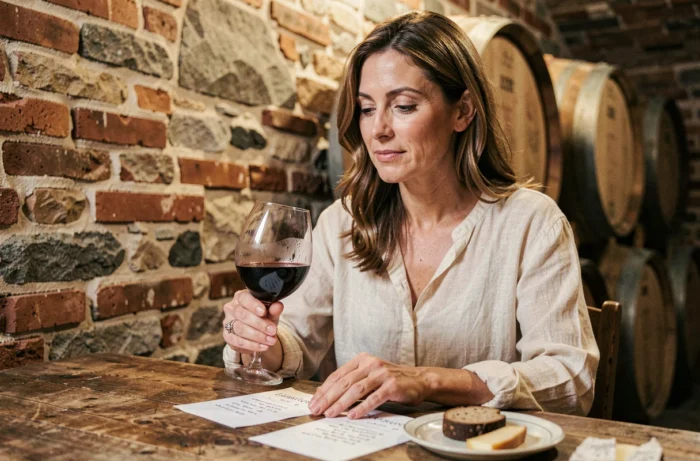
The temperature of a red wine served chilled accentuates its perceived acidity, bitterness and astringency, while reducing the aromas you can detect. Served warmer, the same wine expresses more fruit, spice and sweetness. This finding, based on recent sensory studies, challenges the idea of a fixed “ideal” serving temperature. That’s where tasting begins: accepting that sensations shift, and working with that change rather than against it.
Temperature variation and the perception of wine aromas
A glass of wine starts warming as soon as it is placed on the table. A model published in 2024 in Applied Sciences confirmed that the temperature changes significantly within the first few minutes of serving. The aromatic profile perceived by the taster is therefore never static.
In practice, the first sip of a white wine straight from the fridge delivers lively acidity and little aromatic complexity. Five minutes later, floral or fruity notes emerge. Ten minutes after that, the wine feels rounder on the palate. Its chemical composition has not changed. The perception has.
We recommend making the most of this evolution rather than simply letting it happen. Instead of searching for the perfect temperature window, taste the same glass at regular intervals. Note what emerges and what fades. This comparative approach using a single sample trains the palate far more effectively than tasting a succession of different wines, each served at the “correct” temperature.
To explore tasting techniques further and discover resources for discerning wine lovers, visit https://lartdugout.fr, a rich source of in-depth information on these topics.
Sensory descriptors: naming an aroma is not the same as reading a chemical label
When a taster says “black cherry,” they are not detecting a black cherry molecule in the glass. Naming an aroma is a perceptual experience, not a direct reading of the wine’s composition. Recent research in sensory analysis shows that the descriptors used by tasters do not always correlate with the volatile compounds identified in a laboratory.
This has a direct practical implication: searching for the “right” tasting note is a trap. Two experienced tasters faced with the same glass under the same conditions may use different descriptors without either being wrong. Context, expectations, olfactory fatigue, the previous meal—all of these play a part.
Breaking the habit of seeking confirmation
Most tasting guides present aromas as boxes to tick: red fruit, forest floor, vanilla. This framework provides a shared vocabulary that is useful for communication. It becomes an obstacle when tasters try to confirm what they “should” be smelling instead of describing what they actually perceive.
Precise tasting means describing before identifying. Before reaching for the word “blackcurrant,” describe the sensation: intensity, where it sits in the nose (up front or deep), duration and development. This descriptive work may be less showy, but it sharpens olfactory memory far more than a catalogue of fruit aromas.
Comparing wines under controlled conditions: the method amateur tasters often overlook
Professional tasting panels compare several samples served at the same temperature, in the same type of glass and under neutral lighting. This protocol is not just for laboratories. With a little care, you can use it at home.
- Serve the wines you want to compare at the same time, rather than one after another an hour apart, so your sensory memory can compare closely spaced impressions
- Use identical glasses (shape, volume and thickness) to eliminate glassware as a variable, since it affects how aromas concentrate in the nose
- Write down your impressions of each wine before reading the back label or finding out the price, to eliminate expectation bias
- Return to each glass after twenty minutes to observe how temperature and oxidation have changed the aromas
Comparative tasting trains the palate because it forces the brain to discriminate, not just react. A wine tasted on its own creates an overall impression. Two wines side by side reveal contrasts that are impossible to detect when tasting in isolation.
Expand your frame of reference beyond familiar grape varieties
Recent research in beverage science increasingly focuses on less familiar grape varieties and regions. The benefit for amateur tasters is clear: comparing a Rhône Grenache with a Spanish Monastrell or a Greek Xinomavro forces you to break out of familiar patterns.
The palate develops when it is challenged. Tasting wines beyond your usual frame of reference accelerates sensory learning because the brain can no longer rely on ready-made categories. It has to build new descriptors and associations.
Wine color and sensory expectations: what the appearance suggests before the first sip
Looking at a wine is not a decorative ritual. Its color and intensity create expectations that shape the rest of the tasting. A deep, almost opaque red prepares the taster for a concentrated palate. A pale rosé suggests something light.
These expectations are not neutral. They filter the olfactory and taste perceptions that follow. A taster who sees a golden white wine may expect richness, oak ageing, perhaps some woodiness. If the wine is actually lively and mineral, the perceptual surprise can cloud their judgment for several seconds.
- Tilting the glass against a white background makes it easier to distinguish color nuances at the center and on the disc (the rim), which can indicate the wine’s age
- Tawny hues in a red wine signal development, while greenish hues in a white suggest youth
- Visible viscosity (“tears” or “legs”) indicates alcohol and residual sugar levels, not quality
What the eye sees shapes what the nose and palate perceive. Being aware of this makes it easier to separate what you see from what you actually taste, and to make more precise sensory judgments.
Tasting has no final destination. Every glass sampled under slightly different conditions—temperature, glassware, context or fatigue—offers a new reading. Accepting this variability means moving beyond a textbook approach to a living practice of wine appreciation, where method serves curiosity rather than conformity.


