
The affordable jewelry market has expanded considerably in recent years, with options ranging from stainless steel and gold-plated alloys to 925 sterling silver and resin.
This variety makes choosing more complicated than it might seem: beyond aesthetics, material composition, finish durability, and European regulatory compliance all play a role in how well a piece holds up to everyday wear. Choosing elegant jewelry to elevate an outfit therefore means weighing factors that are rarely considered together.
REACH compliance and everyday jewelry: what materials mean
Jewelry worn every day remains in prolonged contact with the skin, making material safety a regulatory concern as well as an aesthetic one. European REACH restrictions govern, among other things, the release of nickel and the presence of lead and cadmium in components that come into contact with the skin.
The words “stainless steel” or “gold-plated” on a product page do not, on their own, guarantee that every part of the piece (clasp, chain, pendant) is compliant. A 2023 DGCCRF investigation into fashion jewelry and watches also identified non-compliant and hazardous items linked to nickel or lead.
For a bracelet or ring worn every day, the durability of the coating matters just as much as the base metal. A coating intended to limit contact with nickel must prevent excessive release during normal use. A catalog such as tous-les-bijoux.fr lets you compare the materials listed, but documented verification of the components remains the most reliable criterion before buying.
Steel, 925 sterling silver, or gold-plated jewelry: which metal for which use
The choice of metal determines both the style and resistance to wear. Each material has distinct characteristics depending on the type of jewelry and how often it is worn.
- Stainless steel: resistant to oxidation and friction, it is suitable for rings and bracelets worn continuously. Its appearance remains stable over time, but the durability of gold-tone PVD coatings varies depending on the quality of the treatment.
- 925 sterling silver: an alloy containing a high proportion of pure silver, it has a distinctive shine that darkens when exposed to air (surface oxidation). Regular care with a suitable cloth is enough to maintain its luster. It works well for necklaces and earrings, but less so for rings exposed to repeated impacts.
- Gold-plated: a layer of gold applied over a base metal (often brass). The thickness of the layer varies from one manufacturer to another, directly affecting its lifespan. A thin gold plating wears away after a few months of daily wear, while a thicker layer can last for several years.
The table below summarizes the practical trade-offs:
| Metal | Everyday durability | Care | Suitable jewelry |
| Stainless steel | High | Minimal | Rings, bracelets |
| 925 sterling silver | Moderate | Regular | Necklaces, earrings |
| Gold-plated | Variable | Moderate | Necklaces, pendants |
Pairing jewelry with an outfit: proportions before colors
Most guides recommend matching jewelry tones to your outfit. This approach works, but overlooks a more important factor: the proportion of the jewelry relative to the volume of the garment.
A turtleneck calls for a short necklace or drop earrings that frame the face. An open neckline can accommodate a longer pendant without overwhelming the silhouette. The reverse creates a visual imbalance that color coordination cannot fix.
Minimalist outfits and delicate jewelry
A simple look (dark-wash jeans, a white shirt, a plain blazer) gains personality with understated pieces. A delicate bracelet, small hoops, or a simple ring is enough. Layering several delicate pieces works if they are made from the same metal.
Patterned outfits and statement jewelry
Against bold prints or textures, understated jewelry disappears. A single, substantial piece (a bib necklace or geometric earrings) works better, complementing the pattern rather than competing with it. Wearing fewer pieces when an outfit is busy helps avoid visual overload.

Layering jewelry: the often-overlooked drawbacks
Layering necklaces, bracelets, or rings is often presented as an accessible trend. In practice, this technique comes with drawbacks that buying guides rarely mention.
Layering bracelets made from different metals causes micro-friction between the pieces. On gold-plated jewelry, the coating wears faster at contact points. On steel, scratches remain superficial but visible. Mixing metals accelerates mechanical wear on finishes, a factor to consider if you wear your jewelry every day.
Comfort is another concern. Three necklaces of different lengths shift and tangle throughout the day, especially with collared clothing or scarves. The look you create in the morning may not last until evening.
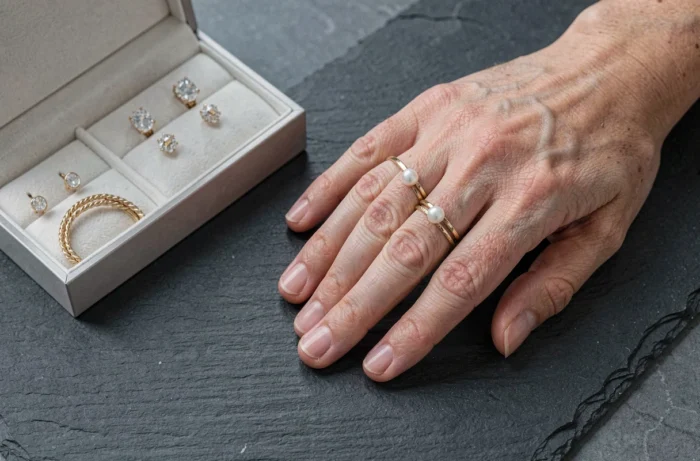
For layering that holds up over time, grouping pieces made from the same alloy and in similar sizes helps reduce both wear and tangling. A pair of delicate rings on the same hand creates enough visual interest without the drawbacks of more ambitious stacking.
Care and storage: how to extend the life of frequently worn jewelry
Elegant jewelry stays that way as long as its finishes remain intact. A few simple habits can make a difference:
- Remove jewelry before showering, exercising, or applying perfume. Chemicals (chlorine, alcohol, surfactants) can damage coatings and tarnish silver.
- Store each piece separately, ideally in a fabric pouch or its own compartment. Contact between pieces can cause scratches and cross-oxidation.
- Wipe 925 sterling silver with a dry microfiber cloth after each wear. For a deeper clean, a warm bath with mild soap is enough.
Storage matters just as much as material choice when it comes to preserving the appearance of everyday jewelry over time. A steel bracelet tossed in with other pieces can get scratched within weeks, even though it could remain intact for years with proper storage.


