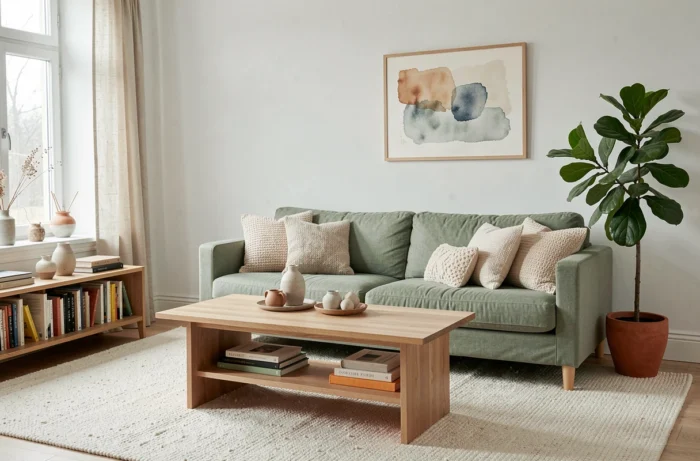
Choosing a floor covering, light fixture or piece of furniture is about more than personal taste. Every decision involves balancing indoor air quality, material durability and aesthetic harmony. Creating an interior that reflects your personality means understanding these technical factors before thinking about colour palettes or decorative styles.
Indoor air quality and the choice of decorating materials
The national CNL2 campaign, conducted in 571 homes between 2020 and 2023, found that reference values for certain pollutants were still being exceeded in some of the homes studied. Furniture, paints, adhesives and floor coverings all contribute to volatile organic compound (VOC) emissions. A decorating project that overlooks this factor misses a fundamental aspect of comfort.
VOC labelling, which is mandatory for construction and decorating products, rates emissions from A+ (very low) to C (high). We recommend checking this label before buying any paint, laminate flooring or particleboard. Low-cost plywood furniture is among the most common sources of formaldehyde emissions.
A useful habit: after installing new floor coverings or bringing in furniture, air the room thoroughly for several days to significantly reduce the initial concentration of pollutants. This simple step complements the choice of low-emission materials.
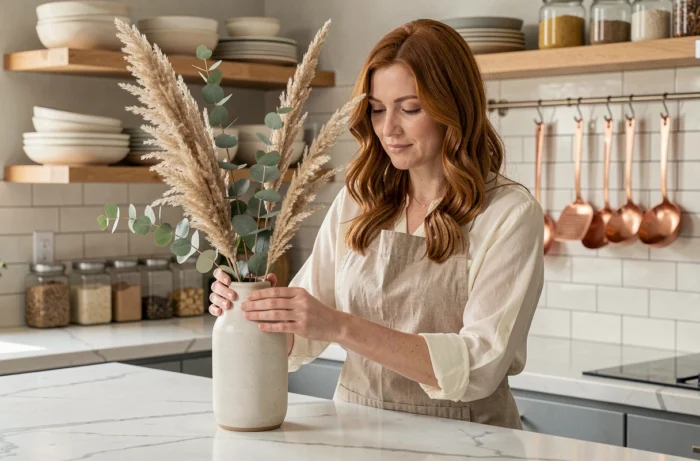
Second-hand furniture and sustainable home decor
Reuse in home decor and furnishing is becoming more established, but availability still varies across different sectors. In its 2024 update, ADEME’s overview describes a sector driven by regulations—particularly the AGEC law—and growing demand, while noting that regional disparities persist. Not every town has accessible reuse centres or furniture repair workshops.
For a decorating project, this means comparing local options before getting started. There are several approaches, each with its own limitations:
- Reuse and recycling centres offer refurbished furniture, often at moderate prices, but stock varies considerably from one centre to another, and distinctive pieces sell quickly.
- Online marketplaces for private sellers can be a good place to find antique or vintage furniture, provided you check its structural condition (joints, finishes and possible lead in old paint).
- Repairing and updating existing furniture (sanding, painting or replacing handles) delivers a personalised result, often for less than buying new, while reducing environmental impact.
Adding second-hand pieces to a contemporary interior creates a visual contrast that standardised new furniture cannot. You can also find ideas for combining these approaches with new items in Déco Maison’s home section.
Summer thermal comfort and interior design
Summer comfort should be considered from the outset when planning your interior, not just when it’s time to install an air conditioner. Room orientation, glazing and interior sun protection all directly affect how warm a space feels during the hotter months.
Interior blinds (roller, Venetian or pleated) play a technical role that is often underestimated in decorating. A light-coloured blackout blind reflects a significant amount of solar radiation before it heats the room. Colour is therefore more than an aesthetic choice: a light-coloured blind reduces overheating more effectively than a dark one.
Thick curtains made from linen or tightly woven cotton provide extra insulation in both summer and winter. Their weight and drape add a textile dimension that blinds alone cannot provide. Pairing a functional blind close to the window with a curtain set further back is an effective solution that doesn’t compromise on style.
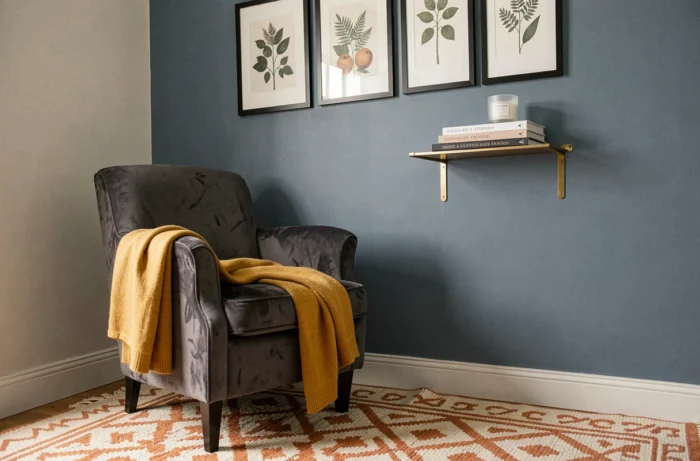
Colour and lighting: creating a cohesive atmosphere in every room
Choosing a wall colour without considering the colour temperature of your artificial lighting is a common mistake. A grey-green shade chosen in a shop under 4,000 K lighting will look noticeably different at home under a 2,700 K lamp. The rule: test every shade in the room where it will be used, with the final lighting in place.
Consistency between rooms doesn’t mean uniformity. A common thread might be a material (wood or brass, for example) or a colour family used in varying intensities. The living room can feature the most saturated shade, the bedroom a muted version of the same tone, and the hallway a related neutral.
When it comes to lighting, layering different light sources is still the most reliable approach:
- General lighting (a ceiling light or pendant) provides the room’s base illumination.
- Accent lighting (adjustable spotlights or wall lights) highlights a decorative object, painting or alcove.
- Ambient lighting (table lamps, string lights or warm-white LED strips) creates an evening atmosphere without glare.
Each layer of lighting changes how colours and shapes are perceived. A dark wall lit from the side by a wall light gains depth. A light wood piece of furniture under a warm spotlight becomes a natural focal point.
Personal objects and wall art: what makes a house feel like home
Objects that tell a personal story—ceramics brought back from a trip, vintage posters or a growing collection of books—don’t follow trends or appear in catalogues. That’s precisely what makes them irreplaceable in a decorating project.
A gallery wall works better with a mix of sizes and frames than with a perfectly symmetrical grid. The arrangement gains character when it combines photographs, illustrations and three-dimensional objects (a small shelf, mirror or wall-mounted plant). Start by laying everything out on the floor, adjusting the spacing, then hang the pieces.
Customisable furniture (interchangeable fronts, modular legs and stackable units) lets you adapt your layout over time without replacing everything. This flexibility has a tangible impact on furniture lifespan and, in turn, your long-term budget.
An interior that reflects your personality doesn’t come together in a single order. It takes shape in layers, as you find new pieces, your life changes and you make technical adjustments. Consistency comes from making choices that work together, not from making them all at once.