The term “high-tech” now covers far more than computing power or screen resolution. It also encompasses device durability, warranty terms and the ability to repair equipment several years after purchase.
Since June 20, 2025, smartphones and tablets sold in the European Union have carried a European repairability label that rates each device according to how easy it is to repair and requires spare parts to be available for several years. This regulation is changing how technology, gaming and connected-gadget enthusiasts assess their devices.
Repairability and refurbished devices: what’s changing for gaming hardware
Video game enthusiasts invest in consoles, gaming laptops and peripherals that rarely last more than four to five years. Until now, repairability was mainly a concern for smartphones. It now applies to the entire high-tech sector.
The European repairability label, already mandatory for smartphones and tablets, foreshadows a likely expansion to other product categories. The associated ecodesign rules require manufacturers to provide certain spare parts for a set period, making repairs possible beyond the standard warranty period.
The refurbished hardware market is expanding to include consoles (Xbox, PlayStation, Nintendo Switch). However, the quality of these devices depends on specific criteria: battery condition, functional tests performed and, above all, after-sales service terms. A refurbished device sold without a warranty or documented inspection is a gamble.
A refurbished device backed by a warranty of six months or more and a test report offers a credible alternative to buying new at a lower price. Gaming and tech enthusiasts keeping up with these developments can find regularly updated resources at https://www.geekmaniac.fr, including information on consoles and peripherals.

Choosing a durable gaming device without compromising the experience
Buying a gaming PC or console based solely on its specifications (processor speed, RAM, GPU) overlooks a crucial factor: the device’s actual lifespan. A powerful GPU installed on a motherboard with non-replaceable components becomes obsolete as soon as it breaks outside the warranty period.
Before making a purchase, it’s worth checking several criteria:
- Whether spare parts are expected to be available, particularly fans, batteries and power supplies, which are among the most heavily used components in gaming hardware.
- The length and terms of the manufacturer’s warranty: some cover only manufacturing defects, while others include normal wear and tear on components such as SSD storage.
- Whether an official trade-in or refurbishment program is available, which indicates the manufacturer’s confidence in the product’s longevity.
For consoles, Microsoft offers a structured repair service for Xbox, while Sony and Nintendo have varying policies depending on the region. Checking these terms before buying can help avoid unpleasant surprises halfway through the product’s life cycle.
Artificial intelligence and gaming: beyond the tech hype
Artificial intelligence in gaming is about more than realistic NPCs (non-player characters). AI upscaling technologies such as Nvidia’s DLSS and AMD’s FSR can display high-resolution images from a lower-resolution internal render. The performance boost is tangible: a mid-range GPU can deliver visuals close to those of a high-end model thanks to these algorithms.
This approach directly affects hardware longevity. A gaming PC with a mid-generation Nvidia or AMD graphics card can remain competitive for longer if games support these upscaling technologies. This extends the replacement cycle, aligning with the focus on repairability discussed above.
AI also plays a role in moderating online games and detecting cheating, two issues that directly affect the player experience. Google and Microsoft are investing in systems that can analyze behavior in real time to maintain a fair gaming environment.
Virtual reality and cloud gaming: two technologies at different stages of maturity
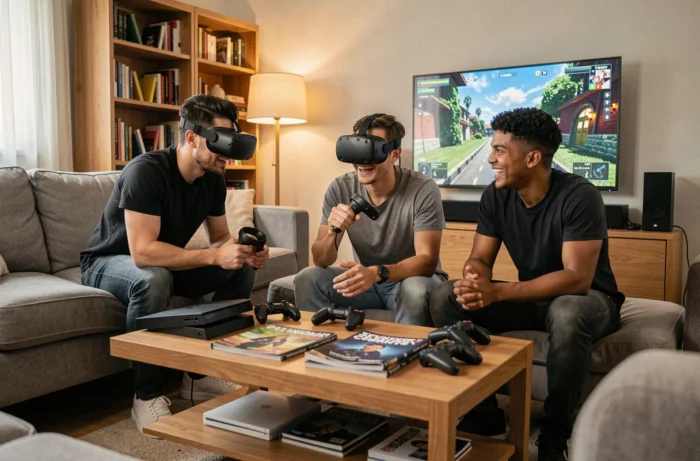
Virtual reality remains a niche gaming segment despite significant advances in hardware. The cost of entry (headset, play space, compatible PC or dedicated console) is holding back widespread adoption. VR game libraries are growing, but most big-budget titles still target traditional screens.
Cloud gaming, offered by services such as Microsoft’s Xbox Cloud Gaming and Nvidia’s GeForce Now, takes a different approach. Games run on remote servers, eliminating the need for powerful local hardware. A modest device is enough, provided the internet connection is stable and fast.
This technology has a direct impact on durability: an entry-level laptop or tablet can serve as a gaming device for many years because the computing power is provided remotely. Refurbished devices therefore make even more sense, as local hardware requirements are lower.
Current limitations of cloud gaming
Latency remains the main drawback. In competitive online games, a delay of just a few milliseconds can make all the difference. Players of fast-paced multiplayer games still prefer dedicated local hardware. For single-player or co-op games, cloud gaming already offers a satisfying experience.
European regulations and video games: developments to watch
The European directive on the right to repair, adopted in 2024, provides for a repair obligation for certain goods, including those outside the warranty period. Its transposition into French law had not yet been finalized as of the latest available checks. Consumers in France therefore cannot yet fully exercise their right to repair their consoles or gaming PCs.
The EU is also considering rules on digital commercial practices that could affect freemium video games, particularly in-game purchasing mechanics. This legislation is still under negotiation and is not yet in force.
These two legislative initiatives are shaping a framework in which gaming technology consumers will have stronger tools to demand repairs and greater transparency about the true cost of games. Keeping up with regulatory developments is now part of tech culture, alongside announcements about new GPUs and upcoming consoles.