
A poorly chewed piece of meat, a bite swallowed while laughing: food slips into the windpipe instead of the esophagus, and breathing can stop within seconds. Every year in France, several thousand people die from choking, making it the second leading cause of accidental death in everyday life. Knowing how to distinguish a partial from a complete airway obstruction, then performing the right steps in sequence, can dramatically improve the outcome.
Partial or complete airway obstruction: tailor your response to the diagnosis
In an emergency, the first mistake is to treat someone who is coughing the same way as someone who is silent. If the person is coughing, even loudly, air is still getting through. Let them cough and encourage them to keep doing so; do not hit them on the back. An ill-judged blow could dislodge the food and turn a partial obstruction into a complete one.
The situation changes when the person can no longer speak, cough, or breathe. They will often clutch their throat, open their mouth without making a sound, and quickly turn red, then bluish. This is a complete obstruction. Act immediately—do not wait for emergency services to arrive.
To understand how to remove food stuck in the windpipe, remember one simple principle: always start with back blows, then move on to abdominal thrusts if the object does not come out.
Back blows and the Heimlich maneuver: the steps to follow
Lean the person forward, placing one hand on their chest to support them. Using the heel of your other hand, deliver five firm blows between the shoulder blades. Each blow should be sharp and directed upward and outward to create pressure that dislodges the food.
If the food is still stuck after five blows, move on to abdominal thrusts. Stand behind the person and place one clenched fist just above their navel, with your other hand over it. Pull inward and upward in a quick motion. Repeat five times.
International recommendations on this point changed in 2025. The American Heart Association now recommends alternating five back blows with five abdominal thrusts, whereas the previous American approach placed greater emphasis on abdominal thrusts alone. Alternate between the two sets until the object is expelled or the person loses consciousness.

Pregnant people and people with larger bodies: chest thrusts instead of abdominal thrusts
If you cannot wrap your arms around the person’s abdomen (in late pregnancy or if they have a larger body), abdominal thrusts may be ineffective or even dangerous. In this case, replace the Heimlich maneuver with chest thrusts.
The technique is similar to performing CPR while the person is standing: place your fists in the middle of the breastbone, not on the abdomen, and thrust backward. Continue with five back blows followed by five chest thrusts.
This distinction is rarely taught in public first aid courses, even though it applies to common situations. In a pregnant person, a poorly placed abdominal thrust could injure the uterus. Remember: if you cannot wrap your arms around the abdomen, move your hands up to the breastbone.
Warning signs after food stuck in the windpipe has been expelled
The food is out, the person is breathing again, and everyone breathes a sigh of relief. This is precisely when you need to remain especially vigilant. Several situations call for medical attention or a call to 15, even if the person seems to have recovered.
- A persistent cough or difficulty breathing in the hours afterward may indicate that a piece of food is still lodged deeper in the airways, beyond the reach of external maneuvers.
- Abdominal or rib pain after choking-relief thrusts warrants a medical examination: abdominal and chest thrusts can both cause internal injuries (a broken rib or organ damage).
- Hoarseness, difficulty swallowing, or the feeling that something is still stuck in the throat may indicate irritation or swelling of the airways, which can get worse.
Extra caution is needed for children under five. Small pieces of food (peanuts, pieces of apple, whole grapes) can enter the bronchi without causing immediate choking, but may lead to a lung infection in the following days. If in doubt, seek medical advice.
Choking in infants: a different technique to know
The procedure is very different for a baby under one year old. Never perform the Heimlich maneuver on an infant. Lay the baby face down along your forearm, with their head slightly lower than their body, and deliver five blows between the shoulder blades with the heel of your hand.
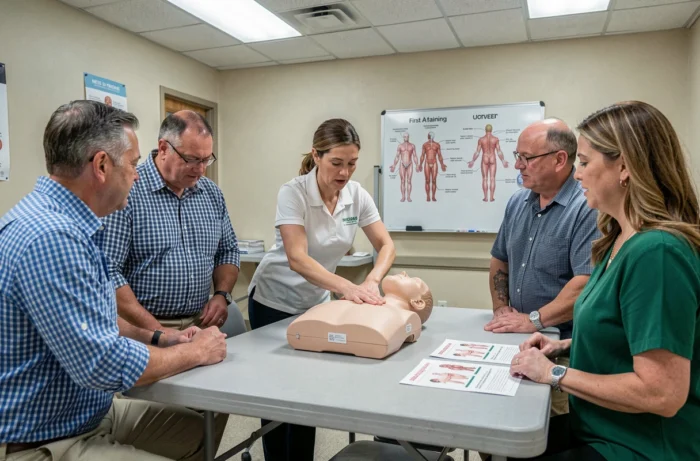
If the obstruction persists, turn the baby onto their back, still supported on your forearm, and give five chest thrusts with two fingers in the middle of the breastbone. Alternate between these two sets. The technique requires precision because an infant’s rib cage is fragile. Taking a first aid course with a training mannequin is the best way to learn it.
When exactly should you call 15 or 112?
Call emergency services as soon as the obstruction is complete and the first back blows have not worked. If you are alone with the person, perform the maneuvers for two minutes, then call—unless someone else can call at the same time.
If the person loses consciousness, lay them on the floor and begin cardiopulmonary resuscitation while waiting for emergency services, even if their heart is still beating: chest compressions may help expel the object.
Choking on food is an emergency where every second counts. Knowing the sequence of back blows followed by thrusts, adapting it to the person’s size or age, and above all continuing to monitor them after the food has been expelled: these three steps cover the vast majority of situations encountered in everyday life.


