
A child starting nursery, a teenager going through a crisis, a parent exhausted by the mental load: every stage of family life raises different questions. General advice can help, but it quickly reaches its limits when situations become more complicated or resources are scarce. Knowing where to find practical, community-based or professional support can make a far greater difference than yet another list of best practices.
Local support for families: practical help that often goes unnoticed
Have you heard of parent-and-child drop-in centres? These spaces, known as LAEPs, welcome children under six accompanied by a parent. Families can drop in freely, with no registration or appointment required.
The idea is simple: families talk with one another and with trained professionals. It is neither a consultation nor a structured workshop. It is a place to ask a question, see how other people do things, or simply take a breather in the company of supportive adults.
For single parents, those who have recently moved, or those without a nearby family network, a LAEP can break the isolation that online advice cannot reach. Families can also find information there about social support available in their town or department.
Other services are available depending on the area, including community centres, family centres and PMI clinics. What they have in common is that no one has to prove they are struggling to walk through the door. Finding these local services in the family section of Annuaire des Enfants can save time when you are not sure where to start.
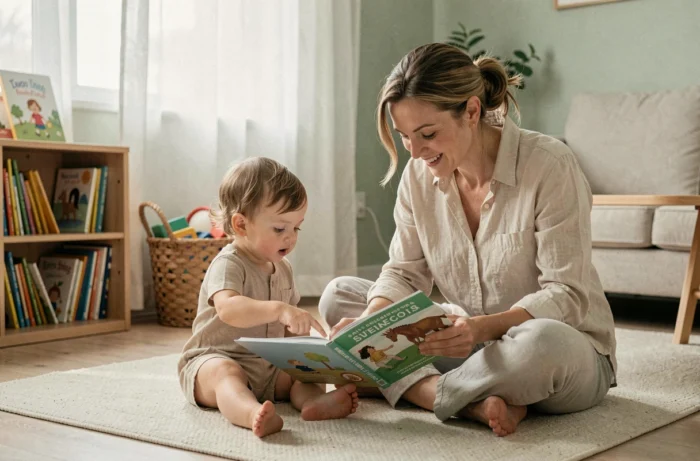
Parenting support: when general advice is no longer enough
Articles on baby sleep, managing screen time or evening routines cover common situations. But what can you do when a child has persistent behavioural problems, a parent is going through a depressive episode, or the strain of daily life is putting pressure on a relationship?
Recognising when professional support could help
A common sign is repetition. The same conflict keeps coming up every evening, a child’s angry outbursts become more than the family can manage, or a parent feels they are losing their footing despite their best efforts. A recurring impasse is a reliable sign that outside help may be needed.
Seeking help does not mean you have failed. Parenting professionals—including psychologists, relationship counsellors and specialist educators—can help with specific issues. A sleep problem that has persisted for months in a three-year-old calls for targeted support, not another article.
Evaluated programmes rather than trendy methods
Not all support programmes are equally effective. Some have been evaluated to measure their impact on families. Choosing a programme with measured benefits helps protect families from ineffective approaches.
The Terra Nova report recommends rolling out parenting support programmes with documented effectiveness on a large scale. The same principle applies at an individual level: before signing up for a workshop or ongoing support, check whether it is based on recognised practices to avoid wasting time and energy.
Inequalities in access to family resources: an issue guides overlook
Most family advice is based on an implicit assumption: that parents have time, reliable internet access, the money to buy books or pay a professional, and a good enough grasp of administrative French.
This assumption leaves some families out. Parenting support is also an issue of economic and social equality. A single mother working irregular hours has far less flexibility than a dual-income couple with grandparents on hand.
Here are a few practical ways to overcome these barriers:
- PMI consultations are free and available regardless of income. They cover children’s medical check-ups, as well as listening to and referring parents who need support.
- Some local councils fund professionally facilitated support groups that are open to everyone and sometimes run on Saturdays or in the evening to fit around work schedules.
- Departmental family associations affiliated with the UNAF offer mediation, help with paperwork and group workshops, often free of charge or on a pay-what-you-can basis.
The goal is not just to offer good advice, but to make that advice genuinely accessible to every family.

Child development and parental well-being: two things to nurture together
Focusing on your child’s development without looking after yourself can eventually create an imbalance. A parent’s emotions directly affect their child’s emotions, from the very first months.
A parent who is constantly stressed passes that tension on, even unintentionally. Parental well-being is not a luxury; it is essential to a child’s development.
A few practical pointers:
- A parent’s sleep matters just as much as a baby’s. When exhaustion becomes long-lasting, asking someone to step in—a partner, a relative or a home help service through the CAF—is essential.
- Screen time at home calls for shared rules developed together. Santé publique France encourages families to agree on these rules collectively rather than impose one-sided bans.
- Parents need time together without the children. Even if it is brief or occasional, this time protects the relationship and, in turn, the stability of the family.
Supporting families through every stage of life means accepting that needs and answers change over time, that some support comes from outside the family, and that asking for help is part of the journey, not an exception.