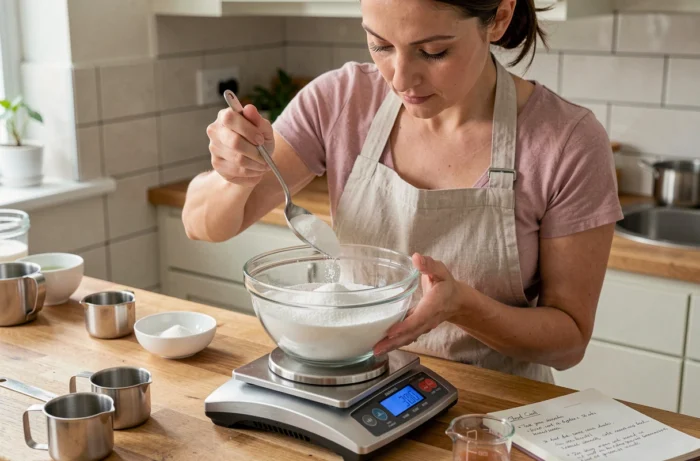
Converting 300 g to millilitres means dividing the mass by the density of the ingredient in question. For water, the calculation is straightforward: 300 g equals 300 ml because its density is 1 g/ml. For flour, sugar or honey, the result can be completely different. Understanding this simple formula and the variables that affect it helps you avoid mistakes in the kitchen.
Ingredient density: the variable that changes everything in the conversion
The conversion formula fits on one line: volume (ml) = mass (g) ÷ density (g/ml). Density tells you how many grams one millilitre of a given ingredient weighs. Water is the reference point, with a density of 1 g/ml, making its conversion trivial.
As soon as you move away from water, the differences become striking. 300 g of flour is about 566 ml (average density of 0.53 g/ml), while 300 g of honey takes up only around 211 ml (density of 1.42 g/ml). Between these two extremes, 300 g of granulated sugar comes to roughly 353 ml (density of 0.85 g/ml). Applying the rule “1 g = 1 ml” to anything other than water can throw off a recipe, sometimes significantly.
So, to convert 300 g to millilitres for any ingredient, you simply need to know its approximate density. The table below lists the most useful everyday values.
| Ingredient | Density (g/ml) | 300 g in ml |
|---|---|---|
| Water | 1,00 | 300 |
| Whole milk | 1,03 | ≈ 291 |
| Vegetable oil | 0,92 | ≈ 326 |
| Granulated sugar | 0,85 | ≈ 353 |
| Wheat flour | 0,53 | ≈ 566 |
| Honey | 1,42 | ≈ 211 |
Flour type not specified in the recipe: adjusting the conversion when the type is unknown
A recipe that calls for “300 g of flour” without specifying the type (T45, T55, T65 or whole wheat) presents a real challenge when converting to volume. Whole-wheat flours are denser than refined white flours, and how the flour is scooped matters just as much as its average density.
Flour spooned into a measuring cup and levelled off takes up more space than flour scooped straight from the bag and packed down. For the same weight, the volume can vary considerably depending on the method used by the recipe’s author. A fixed conversion to millilitres therefore does not guarantee the same actual amount from one preparation to another.
A practical approach when the details are unknown
When the flour type and scooping method are unknown, weighing is still the most reliable option. If you don’t have a scale, using the density of standard wheat flour (about 0.53 g/ml) gives you a reasonable starting point: around 566 ml for 300 g.
You can then adjust the amount by checking the dough’s texture to make up for any imprecision. A dough that is too dry indicates too much flour; sticky dough indicates too little. Checking the texture makes up for what the conversion cannot guarantee.
US cup and metric cup: a common pitfall in international recipes
English-language recipes use the “cup” as a unit of volume. In practice, this term refers to two different measurements, depending on the country of origin.
- The US cup holds about 236.6 ml. For all-purpose flour, King Arthur Baking uses 120 g per cup, while USDA data lists 125 g. A five-gram difference per cup may seem insignificant, but it adds up over several cups.
- The metric cup, used in Australia, Canada and New Zealand, holds 250 ml. Confusing the two means adding about 13 ml of an ingredient per cup, which affects the final result.
- Some older British recipes refer to the 284 ml “imperial cup”, yet another measurement. Checking where the recipe comes from before converting helps avoid a systematic error.
Before converting 300 g to cups, you therefore need to identify the cup size used by the recipe’s author. A cup is not a universal unit, and this confusion is one of the most common causes of baking mishaps.
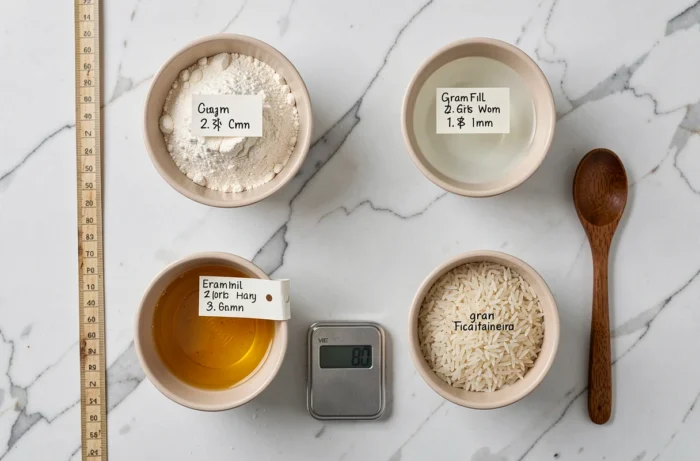
Converting 300 g without a scale: measurements using a glass and a tablespoon
A standard kitchen glass holds about 200 ml. A level tablespoon holds about 15 ml. Once you have converted the weight to millilitres, these two containers can help you measure the volume.
For 300 g of water or milk (about 300 ml), one and a half glasses is enough. For 300 g of granulated sugar (about 353 ml), one and three-quarter glasses will do. For 300 g of flour (about 566 ml), you need almost three glasses, showing just how much volume varies by ingredient.
Limitations of measuring with a glass
The measurement is only approximate. Not all store-bought glasses hold exactly 200 ml, and the fill level varies from person to person. This method works well for a sauce or cake where there is some room for error. For precision baking, a scale is still indispensable.
Reference tables themselves also vary depending on the source. Differences between two databases for the same ingredient are a reminder that any volume-based conversion depends on the reference and measuring method used. Calibrating your own spoon or glass by weighing the ingredient it holds once gives you a more reliable reference than a generic density found online.
Converting 300 g to millilitres is not complicated once you know the ingredient’s density. The key is to check the details beforehand: the type of flour, the cup size used in an international recipe, and how the measuring container was filled. These details can make the difference between a successful recipe and a failed texture.


