Free time is the part of the day left over after work, commuting and household responsibilities. For most adults, that amounts to just a few hours a week, often broken up into short slots.
Choosing a hobby that fits these real-life constraints makes all the difference: the activity needs to fit the time available, the household budget and a reasonable travel distance—or it may remain just a good intention.
How accessible is a hobby? Consider time, cost and location
Many lists of hobby ideas feature activities that sound appealing on paper without checking whether they’re practical day to day. A pottery class a forty-minute drive away or a monthly membership costing three figures will rule out a large share of people.
Before signing up, consider three factors to work out whether an activity is sustainable:
- Time spent actually taking part, including travel. A swimming session at the nearest municipal pool takes between one and one and a half hours, including the journey. A painting class in the city centre may take twice as long.
- Start-up and ongoing costs. Reading only requires a free library card. Knitting involves buying yarn and needles, but the initial outlay is modest and costs stay low after that.
- Distance from home or work. Sports and cultural clubs based in local communities offer convenient access that specialist venues in city centres can’t always provide.
Among Butterfly Mag’s hobby ideas, several meet these criteria, with activities you can do at home or nearby.

Arts and crafts: measurable benefits for stress and anxiety
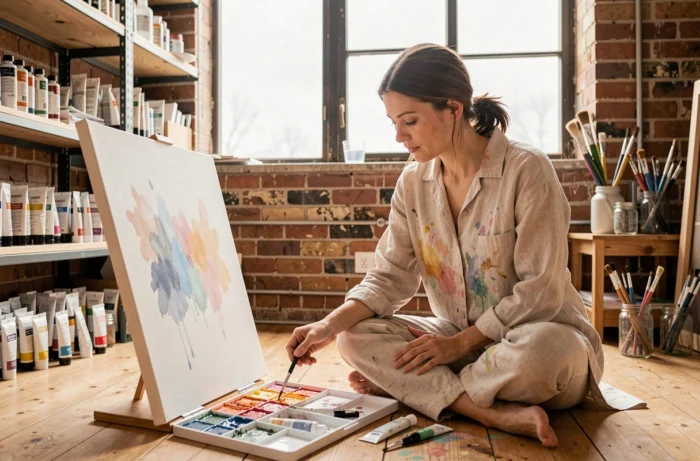
Arts and crafts have a special place among hobbies because they engage fine motor skills and visual attention at the same time. Colouring, knitting, painting and collage all work in a similar way: focusing on a repetitive action helps quiet mental chatter.
Knitting, for example, combines coordination between both hands with a steady rhythm, encouraging a state similar to mindful relaxation.
Choosing a craft to suit your preferences
Not every craft suits everyone. Painting requires a dedicated space and at least some supplies. Colouring, by contrast, only needs a book and a few pencils, so you can do it in the living room, on a train or in a waiting room.
Baking combines creativity with a result you can share, but the preparation and cleanup often take longer than expected. The most sustainable activity is one that fits into your existing routine without friction.
Local sports clubs: a growing way to stay active
Playing sports at a club is about more than choosing an individual activity for your free time. Sports clubs are also places for collective involvement, with set schedules and the social encouragement that helps people stay consistent.
Club memberships increased after the Paris Games. Football, pétanque and chess: popular local activities span a wide range, from highly physical to highly cerebral. This variety makes it easier to find a sport that suits your fitness level and preferences.
Cultural clubs and volunteering
Cultural and leisure clubs follow the same model of local access and regular weekly meetups. Writing workshops, choirs and book clubs can be found in most communities and remain affordable thanks to municipal subsidies.
Volunteering is another often-overlooked way to spend your free time. It offers structure and a sense of purpose, but weekly commitments are becoming less common, giving way to one-off contributions. For someone with an unpredictable schedule, that flexibility can be an advantage.
Cultural outings and reading: a complement to at-home activities
Cultural outings offer a different kind of experience from relaxing at home. Visiting an exhibition, seeing a live performance or exploring a museum engages the mind in a different way: discovery takes the place of the soothing repetition of a hands-on activity.
Municipal policies and community networks help expand local cultural offerings, making it easier to enjoy outings outside major cities too.
Reading: a hobby that costs next to nothing
Reading remains one of the most accessible hobbies in terms of cost and convenience. A library card gives you access to thousands of titles at no ongoing cost. Reading requires no equipment or dedicated space and fits into slots as short as fifteen minutes.
Its benefits for mental health overlap with those of hands-on activities, but through a different mechanism: getting absorbed in a story shifts your attention away from everyday sources of anxiety. Choose a novel, essay, graphic novel or short story to suit the time you have—not the other way around.
The hobby that lasts isn’t the one that looks most impressive on a list of ideas. It’s the one that takes into account the actual travel time, the monthly budget and the free time you really have—not the time you wish you had. A modest activity done regularly has a greater effect on well-being than an ambitious plan abandoned after three sessions.