
The healthcare sector is one of France’s largest employers, with demand that remains strong year after year. An ageing population, a rise in chronic illnesses and large numbers of healthcare professionals retiring are all structural factors that keep future-proof healthcare careers in high demand. Understanding where the real needs lie can help you make better-informed decisions about training or a career change.
Nursing reform and access to care: skills alone are not enough
The nursing profession is undergoing regulatory changes that expand its scope of practice. New responsibilities, such as prescribing certain tests and independently monitoring patients with chronic conditions, are intended to ease pressure on medical practices and hospital departments.
In theory, these expanded skills should improve access to care, particularly in areas with too few doctors. In practice, implementing these reforms faces organisational hurdles. Healthcare providers need to adapt their internal protocols, train management teams and review decision-making processes.
Digital tools present a related challenge. Without suitable coordination software, nurses’ new skills remain underused. A nurse authorised to prescribe a blood test gains nothing if their organisation’s information system does not allow them to do so directly. This disconnect between regulatory ambitions and technical realities is slowing the effective rollout of advanced practice. Several emerging roles among tomorrow’s healthcare professions at AP-HP illustrate the tension between expanded skills and available resources.

Healthcare jobs in demand: beyond the usual list
Competitors routinely cite the same roles (nursing assistant, nurse, home care worker). These professions do indeed offer large numbers of jobs, but recruitment trends are not uniform.
Nurses: the role with the most vacancies
Most healthcare job vacancies are concentrated in nursing roles. This imbalance means that candidates trained in other paramedical specialties do not have access to the same depth of opportunity. For career changers, pursuing nursing training remains the safest choice for immediate employability.
Nursing assistants and home care: plenty of jobs, but what kind of contract?
Nursing assistant roles account for a large number of vacancies, driven by demand from nursing homes and social and healthcare facilities. Recruitment in home care is also growing rapidly. The caveat is the type of contract on offer: part-time hours, split shifts and repeatedly renewed fixed-term contracts. Prospects vary depending on the role and the type of contract offered.
These conditions partly explain a trend documented by job platforms: searches for healthcare jobs are increasing, but a relatively small share of clicks on vacancies leads to an application. The sector’s appeal does not automatically translate into successful recruitment.
New healthcare professions: what ANAP expects
The French National Agency for the Performance of Healthcare and Social Care Organisations (ANAP) works to anticipate changes in roles across healthcare and social care facilities. Some of these roles already exist abroad, while others combine elements of existing positions.
- Robotic surgery nurse: this role supports the growing use of robot-assisted surgery in French operating theatres.
- Clinical ethicist: a role focused on supporting complex medical decisions at the intersection of law, philosophy and care.
- Patient experience manager: this position coordinates the patient journey through a facility, from admission to discharge, with a focus on continuous improvement.
- Mental health peer support worker: a professional who draws on their own experience of illness to support other patients, a common model in English-speaking countries.
There is no guarantee that these roles will be adopted in the French system. Collective agreements, pay scales and training frameworks will need to evolve to accommodate them. Organisations that anticipate creating these positions can attract candidates looking for more distinctive roles.
Training and career changes in healthcare: practical guidance
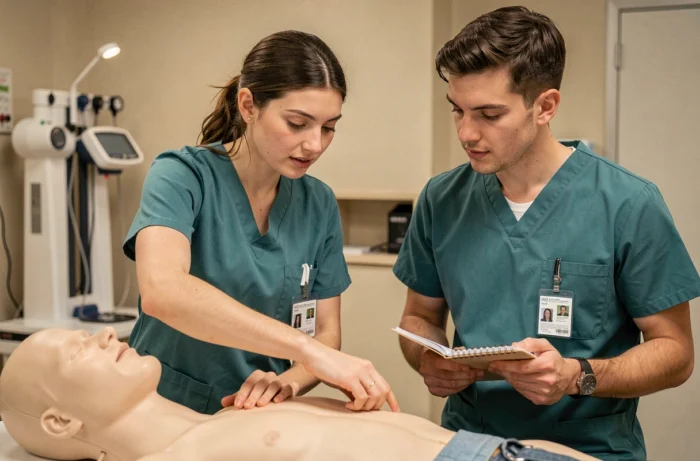
Entry into healthcare professions requires regulated training, with course lengths and admission requirements varying considerably.
Career changers have several options: recognition of prior learning (VAE) for experienced nursing assistants, or entry to a nursing training institute (IFSI) through continuing vocational education.
Not all the emerging roles identified by ANAP yet have dedicated training programmes in France. Training provision needs to catch up with the changing needs of healthcare facilities. Candidates targeting these fields (robotic surgery, telehealth and care pathway coordination) will often need to supplement their initial training with specialist certifications or experience abroad.
The healthcare sector is hiring and will continue to do so. The real dividing line is not between in-demand and oversaturated professions, but between roles where skills, tools and organisation work together and those where one of the three is lacking. An informed candidate chooses not only a profession, but also the environment in which they will practise it.