
The Parkside polyurethane stain sold at Lidl attracts attention due to its price, but the mention of “polyurethane” on the label does not guarantee compatibility with all surfaces or a level of protection equivalent to professional stains. Before comparing this product to market references, it is essential to first read what the label truly says, and especially what it does not say.
Parkside polyurethane stain: what the technical data sheet does not always specify
The term “polyurethane” refers to the binding resin of the film. In a stain, this resin improves mechanical resistance and UV stability compared to a standard alkyd resin. However, the resin alone does not define the permitted use.
On Parkside products distributed by Lidl, the technical data sheet does not systematically indicate whether the stain is suitable for exterior horizontal surfaces (decks, flooring). A deck experiences water stagnation and abrasion stresses that a vertical cladding does not. Applying a stain not intended for horizontal surfaces amounts to ensuring premature peeling.
Another point to check: the presence or absence of biocides. A decorative stain and a wood preservation product do not serve the same purpose. Protective biocides fall under the TP8 product type, regulated by the European regulation on biocidal products. If the Parkside label does not explicitly mention a fungicidal or insecticidal action, the product only protects the wood against the elements, not against wood-destroying fungi.
A comparison of the Lidl Parkside polyurethane stain allows for cross-referencing this technical data with field feedback on different wood species.
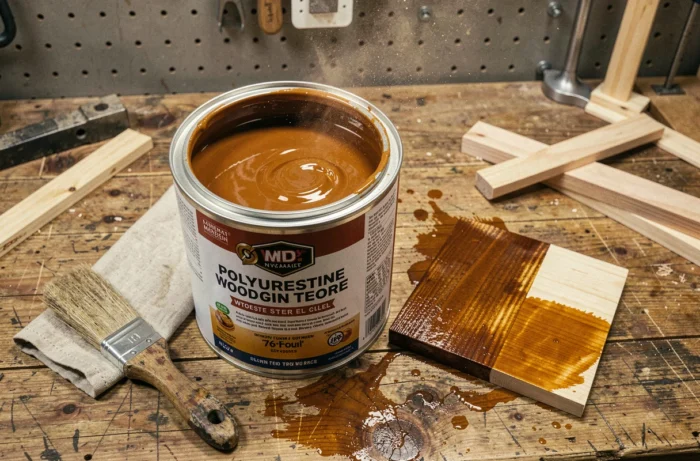
Surface preparation: the factor that the brand does not compensate for
The preparation of the old coating conditions the result more than the chosen brand. This observation is echoed in the majority of user feedback, whether the stain is a Parkside, V33, or Sikkens.
On an old stain that is starting to powder or blister, a simple surface sanding is not enough. The new film adheres to the residues of the old one, and peeling reappears within a few seasons. Chemical stripping or thorough sanding remains the only reliable method to start with a sound base.
Checkpoints before application
- Check the moisture content of the wood with a pin moisture meter: above 20%, the stain does not penetrate the fibers properly, and drying will be compromised
- Remove any signs of graying with a suitable wood brightener for the species, then rinse thoroughly before allowing to dry for several days
- Apply a separate fungicidal treatment if the chosen stain (Parkside or otherwise) does not contain the TP8 biocide mentioned on the label
A user who neglects these steps will achieve a disappointing result even with a high-end stain. Conversely, rigorous preparation allows an entry-level product like Parkside to hold up properly on vertical cladding for several seasons.
Market alternatives: where does Parkside stand against Bondex, V33, and Sikkens
Comparing stains without setting criteria is akin to comparing prices per liter without considering yield or the number of coats required. Here are the comparison axes that truly matter.
Yield and number of coats
A cheaper product per liter can end up costing more per square meter if the yield is low or if three coats are needed where two suffice with a competitor.
The Parkside range positions itself at a low purchase price, consistent with Lidl’s strategy. The actual cost depends on the substrate, the porosity of the wood, and the number of coats.
Durability and user feedback
Feedback on DIY forums shows that the Parkside stain provides acceptable results on less exposed vertical woodwork (shutters, sheltered fences). On heavily used surfaces, users report faster powdering than with brands like Bondex or V33.
Bondex and V33 offer ranges specifically formulated for decks, with resins and anti-slip additives absent in Parkside. For decking, these references remain more suitable.
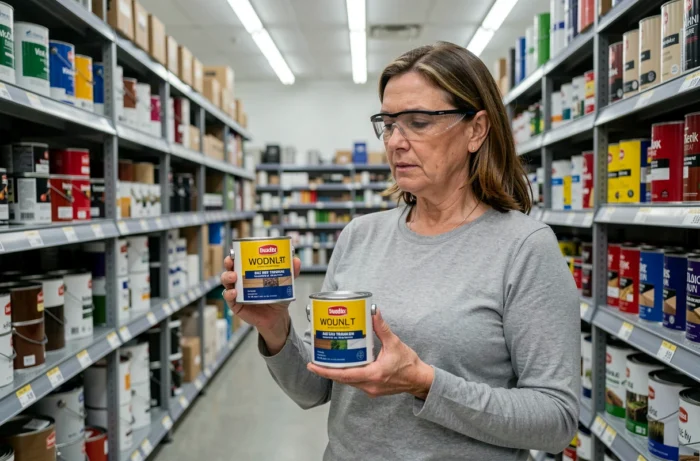
Lidl Parkside stain: for what use and what type of buyer
The Parkside stain finds its relevance in a specific context: exterior vertical woodwork of moderate surface area, on properly prepared wood, without the expectation of durability beyond a few seasons. It is a maintenance product, not a foundational treatment.
For a DIY enthusiast who regularly maintains their shutters or a fence, the quality-price ratio remains interesting. The product is not suitable for decks or wood exposed to permanent moisture without additional fungicidal treatment.
Alternatives from Bondex, V33, or Sikkens are justified as soon as the surface is horizontal, exposure to the elements is high, or the interval between two maintenance sessions needs to exceed three to four years. The additional cost at purchase is then offset by a reduced renovation frequency.
The choice between an entry-level stain and a professional reference depends less on the brand than on three parameters: the orientation of the substrate, the rigor of preparation, and the acceptable maintenance frequency. Asking the right question before opening the can prevents having to redo the work two years later.